Conquer Bhutan's classic Druk Path trek
Experience the heart of the Himalayas on the Druk Path, a journey through high-altitude ridges and pristine natural landscapes.
This trek offers a rare blend of scenery and spirituality, taking you from sacred dzongs to silent, high-altitude lakes. While you’ll reach heights between 2400m and 4200m, the well-paced distances allow you to truly soak in the surroundings.
Beyond the trail, you’ll have ample time to explore the cultural landmarks of Thimphu and Paro.
Services
Included:
- 11 nights accommodations in double or twin rooms
- Daily breakfast, lunch and dinner
- Airport transfers in air-conditioned car with English-speaking driver
- Land transfers as per the itinerary
- Trekking gear
- Trekking chef, helper, trek guide, horses for luggage, horsemen
- Activities & admission fees to sites as per the itinerary
- English-speaking guide on excursions
- Bottled drinking water throughout the journey
- Visa fees
- Visa arrangements
- Government SDF and all the taxes
Excluded:
- International flights
- Teas/coffees, drinks
- Tips & gratuities
- Luxury hotels/resorts available at a supplement cost
- Specialized guides available on supplement cost
- Travel and medical insurance for trekking groups
- Activities available at extra cost (mountain biking, river rafting, etc)
- Any extra expenses not mentioned in the itinerary
Optional:
- Hot stone bath
- Luxury camping
Itinerary at a Glance
Arrival transfer from Paro airport to hotel in Paro - Arrival transfer from Paro airport to hotel in Paro - Rinpung Dzong (Paro Dzong) fortress
Paro
Tiger's Nest Temple - Taktshang Hike whole - Drukgyel Dzong - Kyichu Lhakhang
Paro
Paro to Jili Dzong trek
Paro - Jili Dzong campsite
Jili Dzong to Jangchulakha trek
Jili Dzong campsite - Jangchulakha campsite
Jangchulakha to Jimilangtsho Lake trek
Jangchulakha campsite - Jigmelang Tsho campsite
Jimgelang Tsho to Labana/Phajoding trek
Jigmelang Tsho campsite - Labana/Phajoding campsite
Trek from Labana/Phajoding to Thimphu, where our trek ends - Trek from Labana/Phajoding to Thimphu, where our trek ends - Tashichho Dzong
Thimphu
Memorial Chorten - Buddha viewpoint - Changangkha Lhakhang
Thimphu
Transfer from Thimphu to Punakha - Transfer from Thimphu to Punakha - Dochu-La Pass
Thimphu - Punakha
Transfer from Punakha to Phobjikha (Gangtey) - Transfer from Punakha to Phobjikha (Gangtey) - Gangtey Goemba
Wangdue Phodrang
Transfer from Phobjikha (Gangtey) to Paro - Transfer from Phobjikha (Gangtey) to Paro - Outdoor activities around Paro
Paro
Departure from Bhutan - transfer from hotel in Paro to Paro airport. - Departure from Bhutan - transfer from hotel in Paro to Paro airport.
Detailed Itinerary
Arrival transfer from Paro airport to hotel in Paro - Arrival transfer from Paro airport to hotel in Paro - Rinpung Dzong (Paro Dzong) fortress
Day 1: Paro
Arrival transfer from Paro airport to hotel in Paro
Other Transfer: On arrival in Paro International Airport, our guide will welcome you and transfer to your hotel in Paro.
Rinpung Dzong (Paro Dzong) fortress
Excursion: Built in 1646 by Shabdrung Ngawang Namgyal, the spiritual and temporal ruler of Bhutan, the Dzong houses the monastic body of Paro, the office of the Dzongda (district administrative head) and Thrimpon (judge) of Paro district. The approach to the Dzong is through a traditional covered bridge called Nemi Zam. A walk through the bridge, over a stone inlaid path, offers a good view of the architectural wonder of the Dzong as well as life around it. It is also the venue of Paro Tshechu, held once a year in the spring.
Ta Dzong - Paro
Excursion: A one-time watch tower built to defend Rinpung Dozng during inter-valley wars of the 17th century, since 1967 Ta Dzong has served as the National Museum of the country. It holds a fascinating collection of art, relics, religious thangkha paintings and Bhutan's exquisite postage stamps. The museum's circular shape augments its varied collection, displayed over several floors.
Tiger's Nest Temple - Taktshang Hike whole - Drukgyel Dzong - Kyichu Lhakhang
Day 2: Paro
Tiger's Nest Temple - Taktshang Hike whole
Excursion: One of the most famous of Bhutan's monasteries, the splendid Tiger's Nest is perched on the side of a cliff, 900m above the Paro valley floor, and with its somewhat perilous appearance (it's perfectly safe) is considered iconic to local people.
It is said that Guru Rinpoche arrived here on the back of a tigress and meditated at this monastery and in the caves around it; hence its name, 'Tiger's Nest'. This site has since been recognized as a most sacred place and is visited by all Bhutanese at least once in their lifetime. A fire in 1998 severely damaged the main structure of building, but this Bhutanese jewel has since been restored to its original splendour. It is a truly stunning sight and a must-see on visiting this very sacred country.
The hike can feel difficult at first, but when in view of this gorgeous building you will hopefully feel the energy to carry on! The views are worth it.
Distance Approx: 7KM
Time: 4 hours total
Elevation: 3200m
Drukgyel Dzong
Excursion: This Dzong, with a delightful village nestling at its foot, was built in 1646 by Shabdrung Ngawang Namgyal to commemorate his victory over the Tibetan invaders. Historically and strategically this Dzong withstood all its glory and was featured in a 1914 video by National Geographic magazine. The glory of Drukgyel Dzong remained even when its was destroyed by fire in 1951. On a clear day, one can see the commanding view of Mount Chomolhari from the village below the Dzong.
Kyichu Lhakhang
Excursion: It is one of the oldest and most sacred shrines of the Kingdom, dating back to the 7th century (the other is Jambey Lhakahng in Bumthang). The lhakhang complex is composed of two temples. The first temple was built by Tibetan King, Songtsen Gampo in the 7th century and in 1968, H.M. Ashi Kesang, the Queen Mother of Bhutan, built the second temple in its original pattern.
Paro to Jili Dzong trek
Day 3: Paro - Jili Dzong campsite
Paro to Jili Dzong trek
Excursion: Although today’s trekking day is short, we keep a slow and steady pace as the altitude gain is significant. After breakfast, you will drive to the road's end at the National Museum (2487m) above Paro from where you will start your trek. We will walk from the Museum heading up hill through apple orchards, smallholdings belonging to the village of Damchena and pine forests. Visit Jili Dzong (3,490m), perched on a whaleback ridge. Jili Dzong is mostly in ruins and there is a Lhakhang with the statute of Buddha Sakyamuni. On a clear day, the views of Paro town far below and of mount Jomolhari (7,314m) are breathtaking. Overnight camp at 3480m.
10km, 4-5 hours
Jili Dzong to Jangchulakha trek
Day 4: Jili Dzong campsite - Jangchulakha campsite
Jili Dzong to Jangchulakha trek
Excursion: Begin with a gradual ascent and then descend below the ridgeline to walk through the trail of thick alpine forests and rhododendrons. You may see yak herders in the area. There are fascinating views of Jhomolhari and other snow capped mountains and you can also hear some monal pheasants during the day. We continue our up hill walk to reach a yak herders’ pasture at Jangchulakha (3,780m) with outstanding views of the Himalayan range. We camp in a yak pasture near the hillside.
10km, 4 hours
Jangchulakha to Jimilangtsho Lake trek
Day 5: Jangchulakha campsite - Jigmelang Tsho campsite
Jangchulakha to Jimilangtsho Lake trek
Excursion: The trail follows the ridge, at times through juniper trees and dwarf rhododendrons. The views of the mountain valleys of Thimphu and Paro are sensational. After making an ascent and then a steep descent, we arrive at Jimilangtsho Lake (3,880m). The lake is famous for its giant sized trout. Near the camp, you have great views of 6,989m Jichu Drake, the peak representing the protective deity of Paro. Overnight camp close to Jimilangtsho Lake.
11km, 4-5 hours
Jimgelang Tsho to Labana/Phajoding trek
Day 6: Jigmelang Tsho campsite - Labana/Phajoding campsite
Jimgelang Tsho to Labana/Phajoding trek
Excursion: The trail takes you through dwarf rhododendron trees and bypasses the lake of Janetsho. You may come across some yak herder’s camps and get an idea how these people live. The trail winds and undulates with magnificent views of the Himalaya across deep valleys. Simkotatsho Lake (4,110m) can be seen below after crossing one final spur. We continue our trek until we reach the yak pasture where we camp for tonight.
11km, 4 hours
Trek from Labana/Phajoding to Thimphu, where our trek ends - Trek from Labana/Phajoding to Thimphu, where our trek ends - Tashichho Dzong
Day 7: Thimphu
Trek from Labana/Phajoding to Thimphu, where our trek ends
Other Transfer: The trails are all downhill and we will end the trek at upper valley of Thimphu.
Tashichho Dzong
Excursion: Tashichho Dzong (the Fortress of Auspicious Religion), is located in the capital and is the seat of the government as well as the monk population. His Majesty the king has his office here. During the winter, the monks move to Punakha, the old capital of the country, where the weather remains moderate when it freezes in Thimphu.
Re-erected in 1968, the fortress suffered several major conflagrations. The central tower around which the fortress is built around is an original section of the old fortress.
The outstandingly complex and subtle architecture of the fortress is one of the finest in the country. The fortress stands with the perfect expression alongside the Wang Chhu River in the Thimphu valley.
Memorial Chorten - Buddha viewpoint - Changangkha Lhakhang
Day 8: Thimphu
Memorial Chorten
Excursion: This memorial structure forms an important historical landmark in Thimphu city. It was constructed by the revered Dung–se Rinpoche at the behest of the late Royal Grandmother (Ashi Phuntsho Chhodron) in 1974, in memory of her son - the third king Jigme Dorji Wangchuck, who died in 1972.
His remains are in Kuje Lhakhang in Bumthang, but people pay their respects to his photograph mounted on an altar inside. The Chorten has great significance in the religious life of the people, and symbolizes, as do all stupas, the levels of the Buddha’s mind and teachings.
The Chorten contains three chapels representing the main spiritual themes of the Nyingmapa school. The three storeys contain enormous three-dimensional Mandalas of meditational deitiesl excellent paintings and sculptures reflecting the devout faith of the Bhutanese. Occasionally a religious ceremony is performed here. People throng to offer fragrant incense, butter for the lamps and white scarves (Khadars), and to receive blessings from venerated Lamas.
Buddha viewpoint
Excursion: The tallest Buddha image - which will perhaps be the 8th wonder of the world - is being built in Kuensel Phodrang, a hill overlooking the Thimphu Valley. This is an attraction exclusively designed to commemorate the centenary and the coronation of the fifth king, Druk Gyelpo Jigme Khesar Namgyel Wangchuck, in 2008.
When it's finished, this Buddha will be an incredible work of extravagant architecture. The 169 foot bronze Buddha Dordenma image fits exactly on one acre of land, and is planned to have 17 storeys of different Lhakhangs (monasteries) within it, including the throne. These include three storeys within the throne - two each inside the lotus, waist, chest, face and shoulder and one each in the legs, neck and head.
The Lhakhangs will contain, among other things; 25,000 12in copper images of Buddha Dordenma gilded with gold; eight 10ft standing bodhisattvas; sixteen 6ft high Arahats; King Hashang (Maitreya Bodhisattva), Dharmata Tiger, Sutra Holder and the four direction kings. The third storey to the top will accommodate 100,000 eight inch statues of Buddha Dordenma. There will be a meditation hall inside the throne.
Changangkha Lhakhang
Excursion: The temple is one of the oldest in Thimphu, built in the 12th century. The site was chosen by Lam Phajo Drugom Zhipo. After the death of his son Nyima, his descendants took care of the monastery. Its silhouette, perched high on a spur, is a landmark of Thimphu. The monastery houses Chenrizig (Avolokitesawara), an 11-headed, thousand-armed manifestation as the central statue. The prayer books in this monastery are larger than the usual Buddhist texts. There are large prayer wheels inside the monastery and small wheels on the walls outside. The main guardian deity is named Dom-Tshang.
Tourists are not allowed inside the temple without a permit, but one can sit next to the prayer flag and enjoy a good vista over the Thimphu Valley.
School of Arts and Crafts
Excursion: Not far from the Indigenous Hospital, the Painting School and National Library are located close to each other. At the Painting School, children follow a course in religious drawing and painting, sculpturing, carving and mask making.
Thimphu weekend market
Excursion: People from across the country (especially from the west) come to Thimphu to sell agricultural produce and a whole gamut of goods in the weekend market located next to the national playground, Changlimithang. The market is momentarily shifted to the school soccer ground alongside the river, to revamp the old one into something like that of a shopping precinct.
The weekend market is a place where people from all walks of life congregate to buy the entire week’s rations. Besides being apparently exotic, some vegetables and fruits are also mouth-watering and delectable. Some customers, especially foreigners, are more interested in buying small traditional Bhutanese souvenirs with choices ranging from decoration pieces like carved wooden masks, wooden bowls, and hand loomed fabrics to beautiful and antique jewellery.
Transfer from Thimphu to Punakha - Transfer from Thimphu to Punakha - Dochu-La Pass
Day 9: Thimphu - Punakha
Transfer from Thimphu to Punakha
Car Transfer: En-route we will enjoy a scenic drive on the way to Punakha. The drive passes through beautiful Dochula pass which is at 3150m high. 108 Druk Wangyel Chortens were built over the pass and honoured by the Queen Mother in 2003, making the pass one of the most visited in the area.
If the weather permits, we can enjoy a spectacular view of the highest mountains of Bhutan at a sight that stretches almost 180 degrees. After a photo break, we will continue our drive downhill from the pass.
Estimated travel time: 2 hours 30 minutes
Dochu-La Pass
Excursion: You'll feel alive at the Dochu-La. After 45 minutes of steep climbing from Simtokha, you'll be welcomed by a cluster of proud chortens (stupas) and a succession of wind-blown prayer flags.
In winter or in exceptionally clear weather, the view of the mountains from this point is stunning; an array of peaks including Masang Gang (7194m) above the Laya region; Tshendagang (6960m), Terigang (7060m), Jejegangphugang (7158m), Kangphugang (7170m) and Zongaphugang (7060m) are all spread out in front of you in a vastly impressive panorama. Not forgetting the majestic Gangkar Punsum (7541m) - the highest peak in Bhutan.
Lamperi Botanical Garden
Excursion: The garden is located in the centre of a 47 sq. mile botanical park and has over 46 species of rhododendrons. A very good spot for overnight camping and bird watching.
Chimi Lhakhang Hike
Excursion: The Chimi Lhakhang, situated on a hillock in the centre of the valley, is dedicated to Lama Drukpa Kuenley, who in the late 15th century used humour, songs and outrageous behaviour to dramatise his teachings; and subsequently inherited the name, "Divine Madman".
This temple is also known as the Temple of Fertility. It is widely believed that couples yearning for a child will be blessed with one soon after visiting.
To get to the temple Chimi Lhakhang, it is about 30 minutes' walk across lush fields from the road, leads across picturesque rice paddies to the tiny settlement of Pana.
Distance Approx: 1/2KM
Time: 45 mins
Elevation: 1380m
Alternatives: Anybody can hike to Chimi Lhakhang
Transfer from Punakha to Phobjikha (Gangtey) - Transfer from Punakha to Phobjikha (Gangtey) - Gangtey Goemba
Day 10: Wangdue Phodrang
Transfer from Punakha to Phobjikha (Gangtey)
Other Transfer: Head to Phobjikha. En-route we will pass through Wangdue and Lawala pass in the black mountain region.
Estimated travel time: 3 hours
Gangtey Goemba
Excursion: A Nyingmapa monastery built on a small knoll by Pema Thrinley, grandson of Pema Lingpa, the great Bhutanese saint of Bumthang, in the late 16th century. Known for its lovely paintings and statues, it is ringed with family houses of the gomchen, the religious laymen who worship the work at the monastery. It follows the Nyingma tradition of Buddhism and houses a Shedra (monastic school).
Gangtey Nature Trail
Excursion: The most beautiful and shortest of the existing nature trails in Bhutan. The trail hike starts from the mani (like a Chorten) stone wall to the north of the Ganagtey Gonpa and ends in Khewa Lhakhang. The hike takes about 90 minutes through the pine forest and small bamboo plants. You can see the Phobjkha valley so beautifully from this hike. It is one of the best hike places for nature lovers. During the winter months we can see endangered species of birds, such as Black Neck Cranes.
Distance Approx: 4.2KM
Time: 2 hours
Elevation: 2980m
Alternatives: Crane center for more information about Black Necked Cranes and Phobjikha valley with video show at the center.
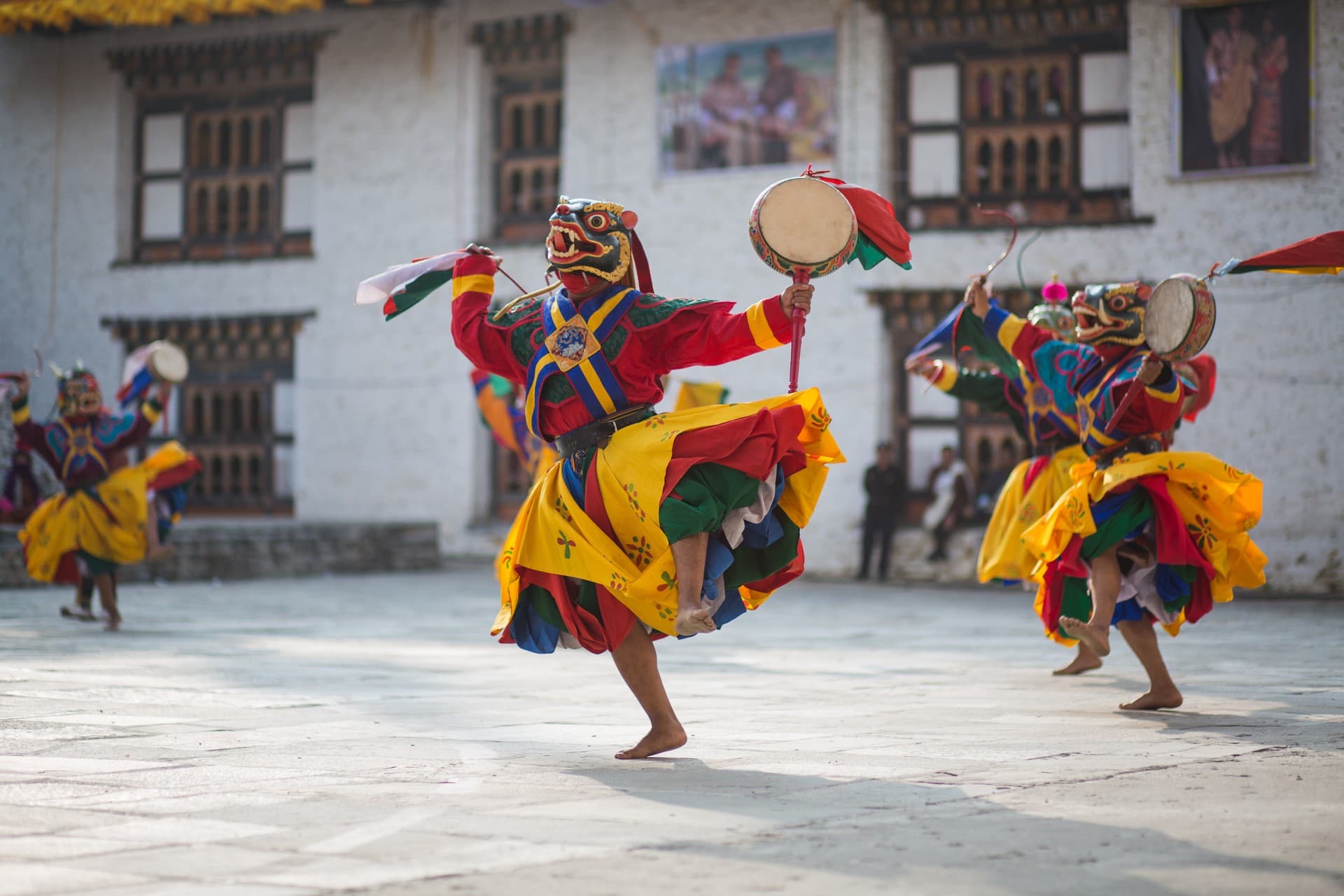
Transfer from Phobjikha (Gangtey) to Paro - Transfer from Phobjikha (Gangtey) to Paro - Outdoor activities around Paro
Day 11: Paro
Transfer from Phobjikha (Gangtey) to Paro
Other Transfer: Sit back for this relatively long journey back to Paro. The route will pass through Wangdue, Dochula Pass and finally crossing Thimphu.
Estimated travel time: 6 hours
Outdoor activities around Paro
Excursion: Today you will get to participate in some cultural outdoor activities at the Souvenir House in Paro. Experiment with a traditional Bhutanese costume, enjoy shooting some archery or playing darts. The more spa-focused among you may choose to enjoy a hot stone bath, followed by a delicious meal of freshly prepared organic food.
Departure from Bhutan - transfer from hotel in Paro to Paro airport. - Departure from Bhutan - transfer from hotel in Paro to Paro airport.
Day 12:
Departure from Bhutan - transfer from hotel in Paro to Paro airport.
Other Transfer: Check out from hotel and transfer to Paro Airport for your onward journey.


